02
2025
Context
METU ID 402, in collaboration with Vodafone
Role
Research, product design, UI design, system design
Team
Solo project

When earthquakes hit, rescue coordination breaks down at the same point every time: the network. Vodamesh is a product-service system that pairs a mesh communication device with a mobile app, so emergency responders keep coordinating when network services are down.
Problem
A product-service system that enhances emergency preparedness by providing a modular, sustainable connectivity solution for emergency responders, enabling seamless coordination when network services are down.
Research
Interviews with elderly and financially vulnerable people, online surveys across the broader community including emergency workers, and observation in public spaces and emergency response contexts produced four recurring findings.
Coordination
There is a huge problem in coordination between workers using walkie talkies.
Communication
Walkie talkies and radios do not allow simultaneous communication between workers.
Tracking
There is a big need to keep some sort of record of the locations already visited.
Training
A huge amount of time is spent training volunteers on tools not designed for them.
Technology
Choosing the stack before the shell
Project Loon, Starlink, GoTenna and the UNHCR connectivity kit were compared on coverage, power dependency and deployment speed. The answer became a hybrid: HF mesh networking for local range, an Iridium satellite module for two-way SOS messaging, Bluetooth for phone connectivity and GPS for location, with every module sized and sourced down to the millimetre. A usage scenario walks the system through a real earthquake: workers equipped with the wearable device and app, victims located, technology as backup and progress recorded in the field.

Ideation
Sketching the device and the app
Form studies tested foldable antennas, speaker placement and screen sizes, while low fidelity wireframes laid out the app pages and the four-button device interface in parallel.

System
Variations, UI progression and the service around it
Two hardware variations were carried forward: a thin vertical unit that hangs from a shoulder strap and a broad screen-first unit. The app matured alongside them, with messaging, a home dashboard, records and maps. The system diagram connects the device to everyone it touches: search and rescue personnel, local survivors, maintenance crews, software engineers and a remote helpline.


Design System
One language, two screens
The design system runs on Inter with four headline levels, a compact icon set and a red that stays consistent with the Vodafone brand. The same hierarchy drives both the phone app and the small monochrome device screen, which is operated entirely through four physical buttons.
Inter · Icon set · Navigation bar · Device UI


Final Device
A wearable unit built for the field
The final device pairs a front screen with four buttons, a foldable antenna, a small solar cell on the back for off-grid recharging, voice messaging over distance and a cloth belt so it can be worn on the forearm or upper arm.


Final App
Onboarding, records, messaging
The app covers onboarding, group messaging for live rescue operations, a journal-style record of milestones, and resources like weather and SOS guidance that matter when infrastructure is gone.

Technicals
Documented to the last screw
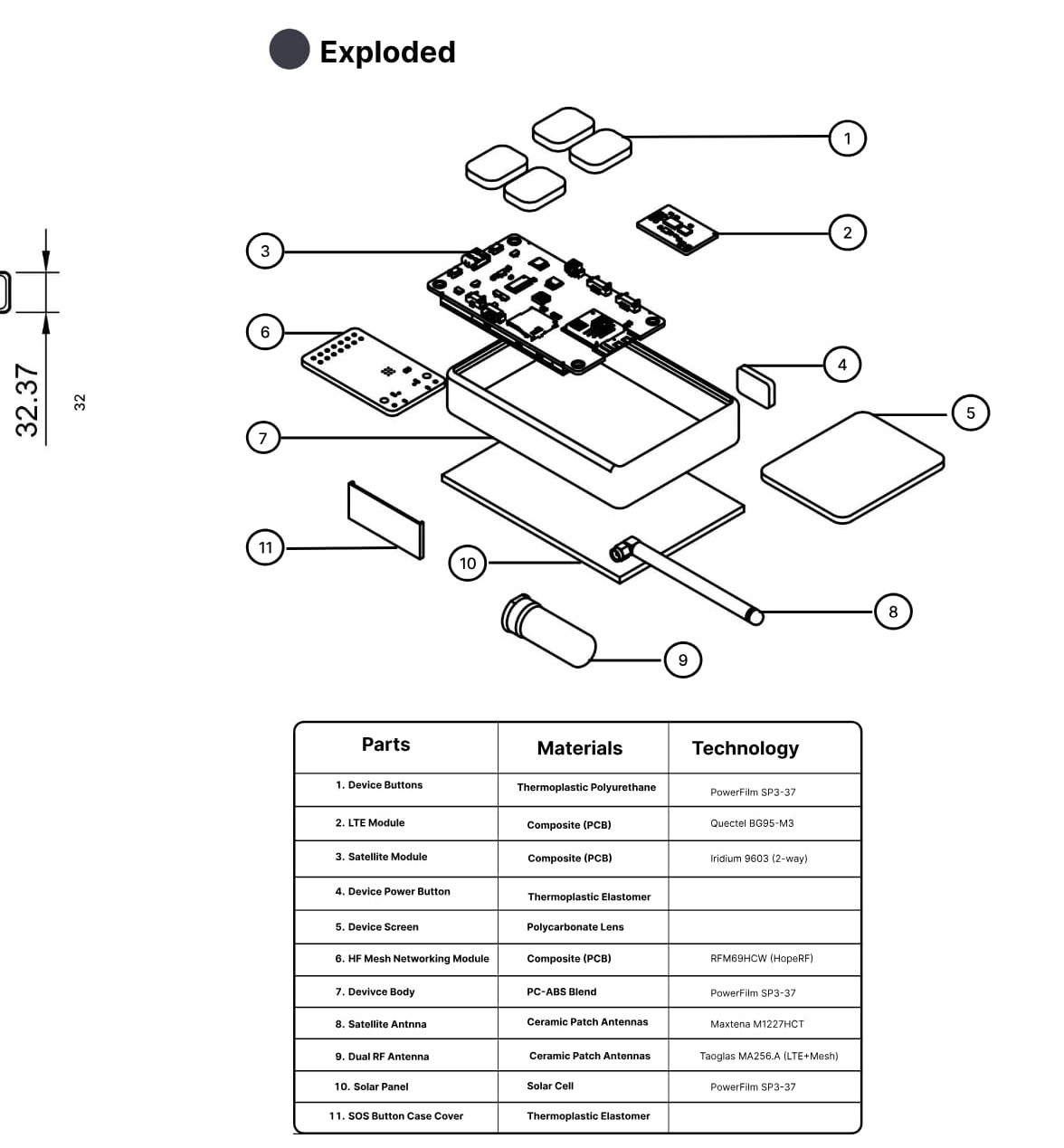
Eleven engineered parts, each with a material and a sourced component: thermoplastic polyurethane buttons, an Iridium 9603 satellite module, a HopeRF mesh module, ceramic patch antennas, a PC-ABS body and a PowerFilm solar panel.

Iridium satellite messaging
HF mesh networking module
mAh battery with solar recharging
Engineered and sourced parts